
From Papyrus To Glass Plate
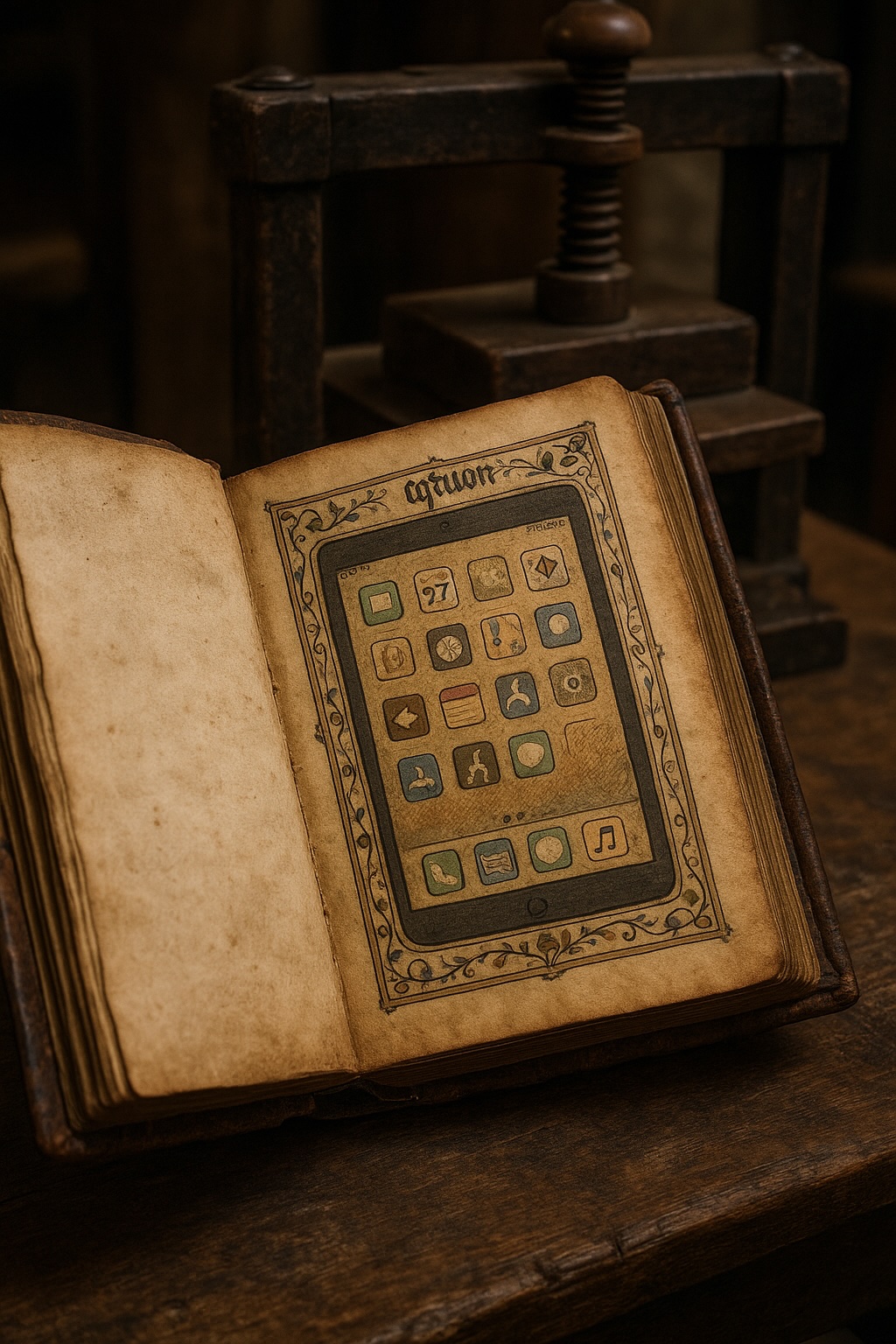
Humanity has always loved rectangular carriers of information. From the clay tablets of the Sumerians to the papyrus sheets of the Egyptians, from medieval parchment codices to the printed pages of paperback books – again and again we have stored, shared, and preserved knowledge in flat, handy formats. When Johannes Gutenberg mechanized the printing press around 1440, he revolutionized production methods but not the basic shape of the medium. A book remained a book – bundled pages in a rectangular form. Five hundred years later, in 2007, Steve Jobs presented the first iPhone. Once again, people stood in awe before a familiar, almost banal form: a rectangle, this time made of glass and aluminum.
Global Lead Media In Just Two Decades
Since then, the smartphone – and in its larger version the tablet – has become the global lead medium. In less than twenty years it has evolved from a luxury item to an almost universal everyday tool. According to Statista, around two-thirds of the world’s population now own a smartphone. In industrialized nations, the share is well above 90 percent; but even in developing regions, a solid Android device can be bought for under €100. Even refrigerators, TVs, or cars cannot match such uniform penetration across all income levels.
A popular sci-fi joke tells of an alien crew parking its spaceship behind the moon and sending a scout to Earth. A week later, the report comes back:
“The locals are fascinating – language, culture, technology … but they have a strange obsession with rectangles.”
“Rectangles?” asks the captain.
“Yes. In the morning they wake up in a big rectangle, push aside a soft rectangle, walk through several rectangles, stand in front of a rectangle, and brush their teeth. Then they sit at a rectangle and eat. On their way to work they constantly stare at a small rectangle. A controller passes by, holds his own rectangle in front of the passengers’ rectangle to check something. Later, they spend the day in front of a very large rectangle, typing on a smaller rectangle filled with tiny rectangles. Back home in the evening, they sink into a soft rectangle and stare at the biggest rectangle in the household. After more toothbrushing in front of a rectangle, they return to the large soft rectangle and even cover themselves with a small soft rectangle.”
The captain nods: “So rectangles are their god?”
“Not quite,” says the scout. “They claim the wheel is their greatest invention.”
The Dream Of The Next Form Factor
Despite this dominance, every few years a prophecy arises that the smartphone is “about to be replaced.” Smartwatches, Google Glass, VR headsets, AI pins – all of them add value but none truly replace. Whenever creativity, longer text input, or detailed visual work is required, even enthusiasts instinctively reach for a smartphone or tablet: touch displays, full-featured apps, and a mature interaction language remain unmatched.
Resilience As An Underestimated Value
Books last for centuries because they require no batteries and can be read by candlelight. Smartphones hold a similar resilience in their cultural role: they provide a visual-haptic “safe space” that works even when speech recognition fails or connectivity drops. Devices like AI pins lose relevance as soon as privacy, noise, or dialect become an issue; AR glasses still struggle with cost, weight, and social acceptance.
Three Conditions For A Major Shift
Historically, new form factors only prevail when they …
- solve an everyday use case radically better,
- make access significantly easier or cheaper, and
- remain compatible with existing content.
The smartphone fulfilled all three points in 2007. An AR headset would also need to deliver on these – only then will it reach the mass market.
AI As Software Layer, Not Hardware Replacement
Large language models, image generators, or personalization systems unfold their greatest benefit right where users already are – on their existing devices. Thanks to Core ML and TensorFlow Lite, style transfers now run locally; Deep Art Creator generates images offline on Macs, NVIDIA GPUs, or modern Intel CPUs.
Creative Workflow On The “Book 2.0”
A designer reads articles on the train in the morning, highlights screenshots, drops a prompt into Deep Art Creator, and gets first drafts before even arriving at the office. All steps – reading, prompting, editing, sharing – happen on the same form factor. No other device integrates so many senses and so much context into one workflow.
What AR Glasses Would Really Need To Deliver
Realistic avatars without latency, lightweight frames under 100 g, edge AI chips, and an affordable price below $1,500. Until all factors align, a decade will realistically pass – and even then, smartphones will likely remain as backups.
Post-Display Scenarios: Quantum, Implants & Schrödinger’s Tablet
Quantum holograms or brain interfaces would be radically different – entirely without visible displays. Yet resilience remains a human need: books persist because paper is independent of electricity; the glass rectangle may endure for similar reasons. Who knows, maybe one day we will indeed carry “Schrödinger’s Tablet” in our pockets: as long as you don’t check, you can’t be sure if you packed it or left it at home. 😉
Until such quantum absurdities become reality, the classic tablet will remain a reliable companion between sofa, office, and train platform.
Deep Art AI: Pocket-Sized AI – Today
Deep Art AI develops tools exactly where users want to experience them: directly on their familiar devices. Both Deep Art Effects and Deep Art Creator offer powerful, local AI experiences on desktop and laptop computers – completely independent of a permanent internet connection. Even a Microsoft Surface Laptop with Intel graphics generates creative results effortlessly, and on a MacBook Air M3 or an Intel-based Surface tablet the process is even faster and smoother thanks to additional compute power. Our mobile apps for Android and iOS complement this experience perfectly by leveraging the cloud to deliver quick and impressive results on the go.